Nodemailer Alternative: Outgrowing DIY Email Infrastructure
Kyle Seyler
November 26, 2025
Table of contents
When Does Nodemailer Stop Making Sense?
What Is Omnichannel Notification Infrastructure?
Why B2B Products Need More Than Transactional Email
How Courier Compares to Nodemailer
What Is a Notification Center and Why Does It Matter?
Slack and Microsoft Teams: The B2B Imperative
When to Migrate from Nodemailer to Courier
Getting Started
Use Courier with AI Agents via MCP
Nodemailer is a solid library. It does exactly what it promises: send emails from Node.js. For side projects, internal tools, and early-stage products, it's often the right choice. Free, flexible, no vendor lock-in.
But there's a moment every growing product hits where Nodemailer stops being a shortcut and starts being a bottleneck. You're not just sending password resets anymore. You're building notification infrastructure for B2B customer journeys that span email, Slack, Microsoft Teams, SMS, push, and in-app messages.
That's when you need something different.
When Does Nodemailer Stop Making Sense?
Nodemailer handles transactional email well. But "email only" becomes a constraint fast when your users expect notifications where they actually work.
You've outgrown Nodemailer when:
- Users ask for Slack notifications instead of email
- Enterprise customers require Microsoft Teams integration
- You need a notification center inside your app
- Product managers want to edit templates without deploying code
- You're debugging delivery issues across multiple providers
- User preferences and unsubscribe management are eating engineering time
- You're duct-taping together SendGrid, Twilio, Firebase, and Slack APIs
At this point, you're not maintaining a library. You're maintaining infrastructure. And that infrastructure is pulling engineers away from your actual product.
What Is Omnichannel Notification Infrastructure?
Omnichannel notification infrastructure means one API, one template system, and unified delivery logic across every channel your users care about. Email, SMS, push notifications, in-app messages, Slack, Microsoft Teams, Discord, WhatsApp.
Instead of integrating each provider separately and writing custom routing logic, you define the message once and let the platform handle delivery based on user preferences, channel availability, and fallback rules.
This matters for B2B products especially. Your users aren't checking personal email during work hours. They're in Slack. They're in Teams. They expect your product to meet them there.
Why B2B Products Need More Than Transactional Email
B2B customer journeys are more complex than consumer flows. A single workflow might involve:
- Email for detailed reports and audit trails
- Slack notifications for real-time alerts to engineering teams
- Microsoft Teams messages for enterprise customers who standardized on Office 365
- In-app notification center for catching up on missed updates
- SMS for critical escalations when other channels fail
Building this yourself means maintaining integrations with SendGrid (or SES), Twilio, Firebase Cloud Messaging, APNs, Slack's API, Microsoft Graph API, and whatever comes next. Each has its own authentication, rate limits, delivery semantics, and failure modes.
That's not a side task. That's a product unto itself.
How Courier Compares to Nodemailer
Nodemailer is a library for sending email. Courier is a platform for notification infrastructure. They solve different problems.
| Capability | Nodemailer | Courier |
|---|---|---|
| Yes (SMTP) | Yes (any provider) | |
| SMS | No | Yes |
| Push notifications | No | Yes |
| In-app notification center | No | Yes |
| Slack notifications | No | Yes |
| Microsoft Teams notifications | No | Yes |
| Visual template editor | No | Yes |
| User preference management | No | Yes |
| Delivery analytics | No | Yes |
| Automatic failover | No | Yes |
| Provider abstraction | No | Yes |
With Nodemailer, you write code for every channel, every provider, every retry. With Courier, you call one API:
Copied!
const { CourierClient } = require("@trycourier/courier");const courier = CourierClient({ authorizationToken: "YOUR_AUTH_TOKEN" });await courier.send({message: {to: { user_id: "user_123" },content: {title: "Your report is ready",body: "Q3 analytics are now available in your dashboard."},routing: {method: "all",channels: ["email", "slack", "push"]}}});
That single call handles routing, templating, delivery, retries, and logging across every channel.
What Is a Notification Center and Why Does It Matter?
A notification center is an in-app inbox where users see all their notifications in one place. It's the bell icon you've seen in every modern SaaS product.
Users expect this now. They want to catch up on what they missed without digging through email. They want read/unread states that sync across channels. They want a single place to manage what notifications they receive.
Building a notification center from scratch takes months of engineering time. You need real-time updates, persistence, read state management, cross-channel sync, and a UI that matches your product's design.
Courier's Inbox SDKs give you pre-built, customizable components for web, iOS, Android, React Native, and Flutter. You can ship a production notification center in days instead of quarters.
Slack and Microsoft Teams: The B2B Imperative
Here's the reality of B2B notification delivery: your users spend their workday in Slack or Microsoft Teams. Email is where messages go to die.
If you want real-time engagement, you need to meet users in their collaboration tools. That means building and maintaining integrations with Slack's Bot API and Microsoft Graph.
Courier handles both natively. You configure the integration once, then route notifications to Slack or Teams based on user preferences or tenant configuration. Enterprise customers on Teams get Teams notifications. Startups on Slack get Slack notifications. Same template, same API call.
This is table stakes for B2B products selling to enterprises. Microsoft Teams support, in particular, is often a procurement requirement that catches teams off guard.
When to Migrate from Nodemailer to Courier
There's no universal answer. But here are signals that it's time:
Strong signals:
- You're integrating a second or third notification channel
- Enterprise customers are asking for Slack or Teams integration
- Product is requesting an in-app notification center
- Debugging delivery issues is taking real engineering hours
- You're building preference management or unsubscribe flows
Weaker signals (still worth considering):
- Template changes require code deploys
- You're managing multiple provider credentials
- Retry logic is getting complicated
- You need delivery analytics you don't have
If you're only sending a handful of transactional emails and that's unlikely to change, Nodemailer is fine. If your notification needs are growing with your product, you're building infrastructure either way. The question is whether you build it yourself or use something purpose-built.
Getting Started
Courier has a free tier and usage-based pricing. You can start with email and add channels as you need them.
Create your account: app.courier.com/signup
The Node.js SDK installs in one command:
Copied!
npm install @trycourier/courier
From there, you can migrate existing email sends incrementally while adding new channels through the same API.
Use Courier with AI Agents via MCP
If you're building with AI-assisted development tools, Courier offers a Model Context Protocol (MCP) server that lets you manage notifications directly from your IDE.
Setup in Cursor:
- Go to Cursor > Cursor Settings > Tools & Integrations > MCP Tools > New MCP Server
- Add the following to your
mcp.json:
Copied!
{"mcpServers": {"courier": {"url": "https://mcp.courier.com","headers": {"api_key": "YOUR_COURIER_API_KEY"}}}}
Pro tip: Courier MCP works best with Agent mode enabled.
What you can do with Courier MCP:
- Send messages: Trigger notifications via templates or custom content to users or lists
- Manage users: Create profiles, fetch user data, manage list subscriptions
- Work with lists and audiences: Create lists, subscribe users, query audience members
- Debug delivery: Check message status, view rendered content, list notification history
- Manage brands: Create and fetch brand configurations
- Trigger automations: Invoke automation templates directly from your IDE
- Generate tokens: Issue JWTs for client-side authentication
Full documentation: courier.com/docs/tools/mcp
Ready to move beyond DIY email infrastructure? Create your free account or talk to the team about your notification needs.
Similar resources
How to Build B2B Customer Journeys
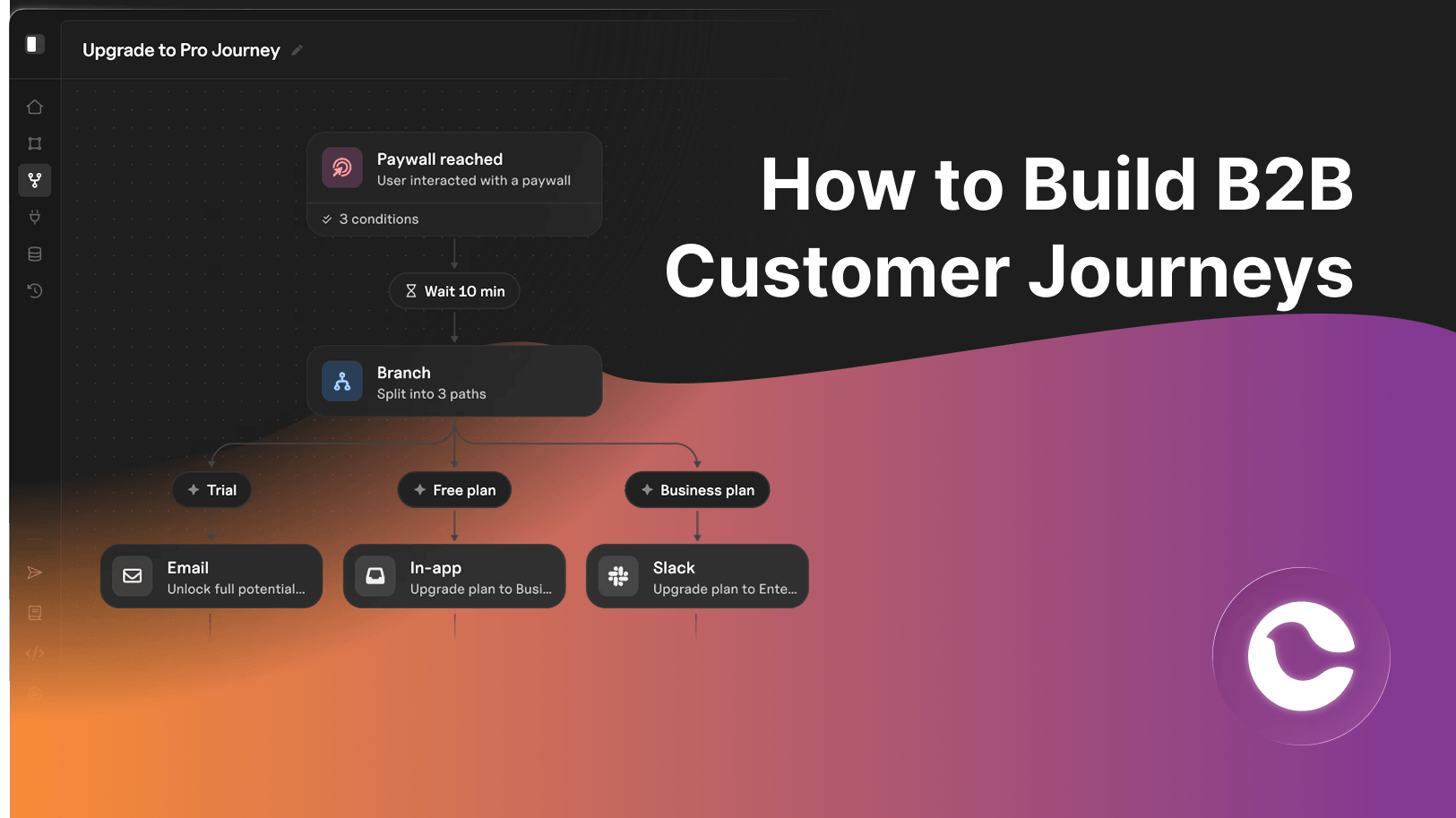
Courier Journeys is an AI-native journey builder for multi-step customer messaging. Build on a visual canvas with branching, delays, live data fetching, AI nodes, and omnichannel sends. Define your payload schema so variables autocomplete throughout the flow. Branch on product events and profile data. Use AI to enrich profiles, drive branching logic, or generate personalized message copy. Throttle messages so customers aren't overwhelmed. Compare draft changes against the live version before publishing. Invoke and test from the CLI or MCP server. Scaffold growth patterns with Courier Skills.
By Kyle Seyler
March 30, 2026
Audit Notifications with Cursor or Claude Code
Most teams can't answer a basic question about their own product: what notifications are you sending, and are they working? This post walks through a full notification audit using Courier's CLI and MCP server from inside your coding environment. You'll inventory every template, pull delivery logs to surface failures, trace messages end to end, inspect rendered content for stale copy, map the data feeding each notification, break down delivery health by tenant, check preference coverage, and build a hit list of notifications to kill, revise, or batch. All from the command line. Takes about an afternoon.
By Kyle Seyler
March 27, 2026

Courier vs Customer.io: Complete Customer Engagement Platform Comparison 2026
Courier and Customer.io both support multi-channel messaging, but they are built for different operators. Courier is the customer messaging platform for humans and agents, designed for product teams, growth engineers, and developers who need intelligent messaging infrastructure across journeys, inbox, preferences, and channel orchestration. Customer.io is stronger for marketers and CRM lifecycle teams focused on profile-driven campaigns, segmentation, a/b testing. This comparison breaks down pricing, workflows, in-app messaging, and best-fit use cases.
By Kyle Seyler
March 24, 2026
© 2026 Courier. All rights reserved.